How to Read Value in Assembly Arduino
AVR Assembly Programming Problems
Programming Problems
- The following programming problems are designed for the Arduino Uno (ATmega328P) with the CSULB Shield. Programs may exist written in AVR Studio iv or Atmel Studio 6.
- To display code, open in Chrome browser or download (Firefox).
1) In this programing problem yous volition write the assembly code needed to display a number between 0 and 9 every bit defined by the least significant 4 switches on your proto-shield (PINC). If the number is greater than nine plow ON the discrete LED wired to PORTB fleck 0, otherwise turn OFF the LED.
I have written much of the code, including calls to subroutines InitShield, WriteDisplay and BCD_to_7SEG. You should exist familiar with the outset two from your Lab piece of work. The BCD_to_7SEG subroutine takes as input a number between 0 and 9 in register r0. The subroutine then converts the decimal number into its respective vii segments and displays answer.
Every bit you write your plan recollect that:
- The to the lowest degree meaning four switches are wired to PINC.
- The error LED is wired to PORTB bit 0
- BCD_to_7SEG'due south calling argument is in annals r0
- Do not modify r16 when yous cheque to meet if it is less than 10
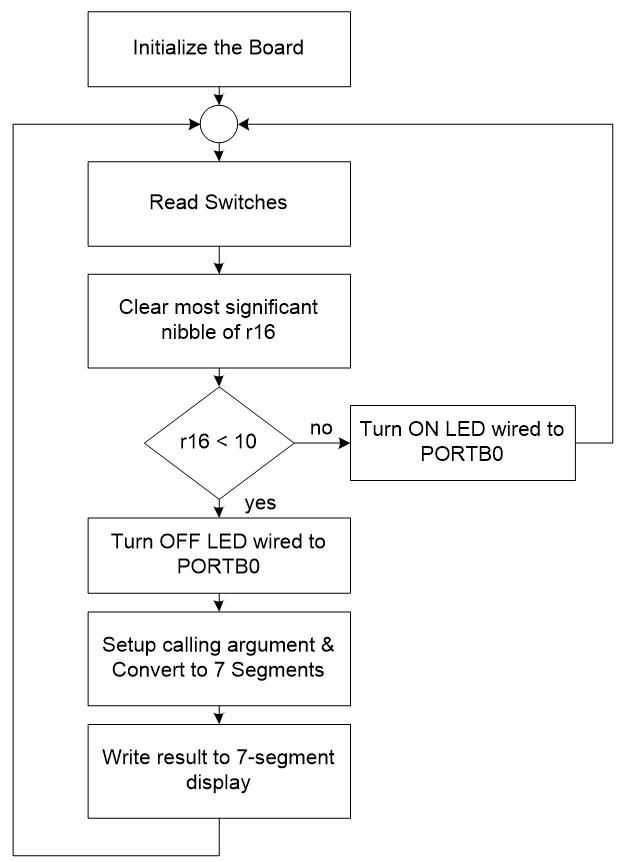
.INCLUDE RST_VECT: rjmp reset .ORG 0x0100 .INCLUDE "spi_shield.inc" reset: ldi r16,low(RAMEND) out SPL,r16 ldi r16,high(RAMEND) out SPH,r16 ; Initialize Proto-shield telephone call InitShield loop: _____ r16, _____ // Read Switches from GPIO Registers _____ r16, 0x___ // clear almost significant nibble _____ r16, 0x___ // Is r16 less than ten10? (see notes) _____ ___________ // unsigned conditional branch _____ ______, ___ // fault - turn on the LED rjmp ___________ // see the flowchart no_error: _____ ______, ___ // non an error - plow off the LED display: _____ ____, _____ // transport statement to subroutine telephone call BCD_to_7SEG // (encounter notes) telephone call WriteDisplay rjmp ____________
two) Write a subroutine named BlinkIt to complement a variable named blink and to and then send the least significant bit (b0)of blink, in SREG bit T, to a subroutine named TestIt. For the purpose of this test you practise not need to relieve registers on the stack for this question.
.DSEG Blink: .BYTE 1 .CSEG BlinkIt: ______ _________ // load variable to register xvi ______ _________ // do something ______ _________ // store register 16 back to variable ______ _________ // store bit 0 to SREG T bit ______ _________ // call TestIt using relative addressing mode ret
Solution
Code
; ---------------------------------------- ; BlinkIt - TestIt ; Version 1.0 ; Date: 10/24/2014 ; Written By : Khoi Vu ; ---------------------------------------- .INCLUDE .DSEG blink: .BYTE one .CSEG .ORG 0x0000 RST_VECT: rjmp reset .ORG 0x0100 .INCLUDE "spi_shield.inc" reset: telephone call InitShield clr spiLEDS // clear discrete LEDs test: rcall BlinkIt rjmp examination BlinkIt: lds r16,blink com r16 // complement r16, since blink=0x00, output= 0xFF sts blink,r16 // store dorsum to blink bst r16,0 // store bit 0 of r16 to T rcall TestIt // call TestIt ret TestIt: mov r16,spiLEDS // motion LEDs to register 16 sbr r16,0b10000000 // guessing LED is on brts washed // since chip 0 of r16 was i T=one so brts is gear up. it will branch to done cbr r16,0b10000000 // articulate r16 if non on washed: mov spiLEDS,r16 // move r16 back to LED rcall WriteDisplay // output to display ret
Simulation
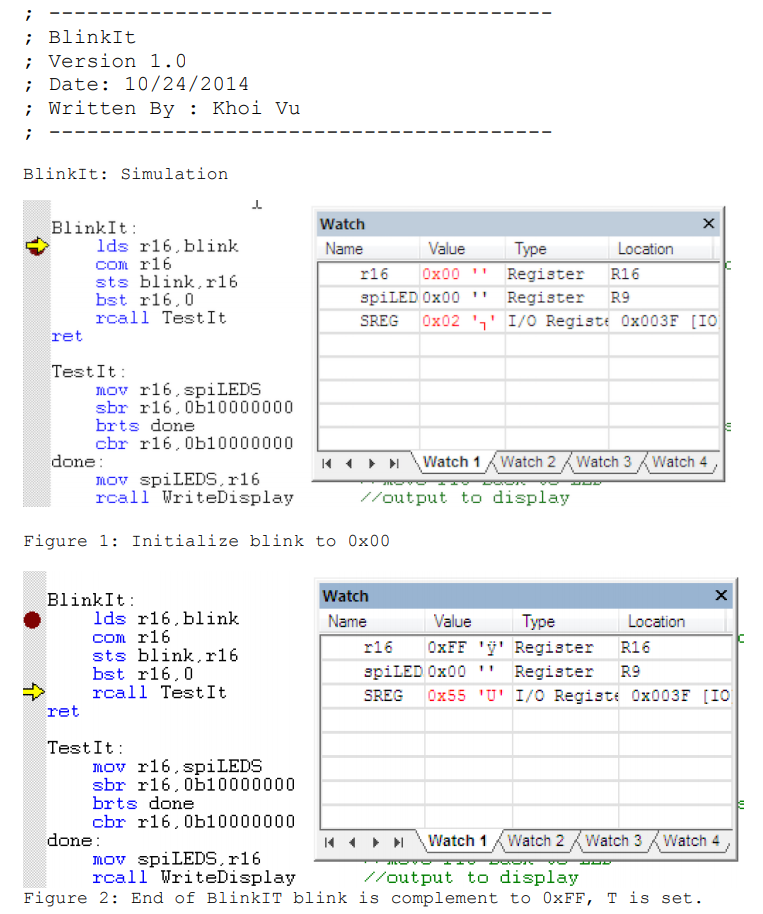
Solution Package
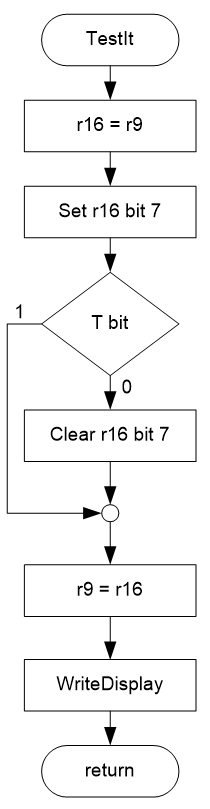
3) The following flowchart defines a subroutine named TestIt which is called past BlinkIt. TestIt therefore accepts the T chip as an argument. We are working with the Arduino Proto-shield (see Proto-shield Schematic). Translate the following flowchart into its equivalent AVR lawmaking. Your lawmaking must implement the flowchart on the right. For the purpose of this exam yous do not need to save whatever registers on the stack for this question.
.DEF spiLEDS = r9
TestIt: ______ _________ ______ _________ ______ _________ ; approximate bit is set ;execute next line just if t = 0 ______ _________ ; guess is wrong
done: ______ _________ ______ _________ ret
Solution
Code
; ---------------------------------------- ; BlinkIt - TestIt ; Version 1.0 ; Engagement: 10/24/2014 ; Written By : Khoi Vu ; ---------------------------------------- .INCLUDE .DSEG blink: .BYTE 1 .CSEG .ORG 0x0000 RST_VECT: rjmp reset .ORG 0x0100 .INCLUDE "spi_shield.inc" reset: telephone call InitShield clr spiLEDS // clear discrete LEDs test: rcall BlinkIt rjmp test BlinkIt: lds r16,blink com r16 // complement r16, since glimmer=0x00, output= 0xFF sts blink,r16 // store back to blink bst r16,0 // store bit 0 of r16 to T rcall TestIt // phone call TestIt ret TestIt: mov r16,spiLEDS // move LEDs to register 16 sbr r16,0b10000000 // guessing LED is on brts washed // since bit 0 of r16 was 1 T=ane so brts is set. it will co-operative to done cbr r16,0b10000000 // clear r16 if not on done: mov spiLEDS,r16 // move r16 back to LED rcall WriteDisplay // output to display ret
Simulation
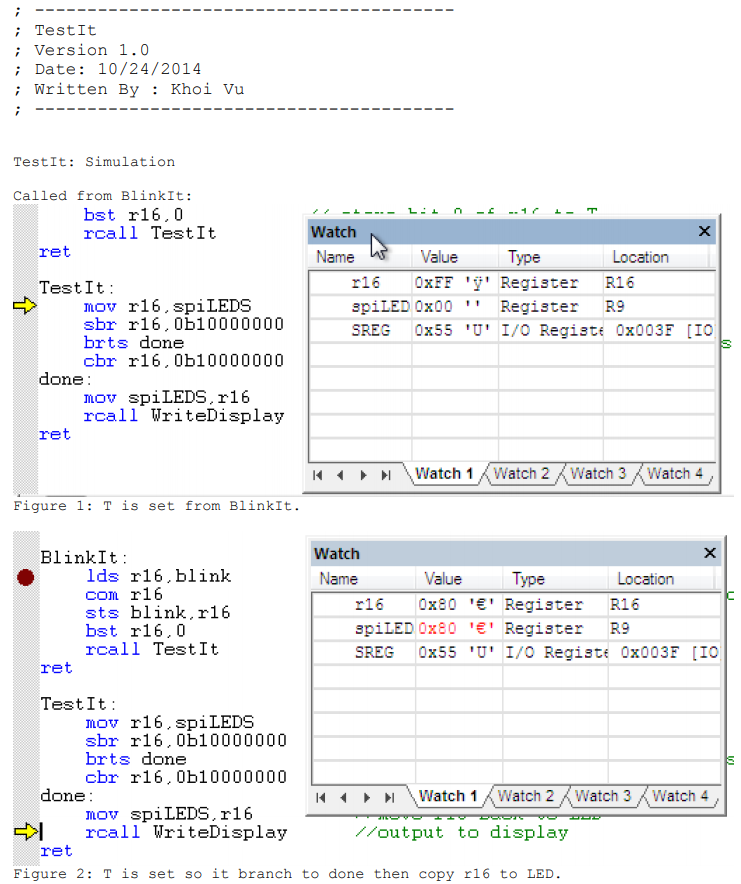
Solution Parcel
4) Given variables A and B, each belongings an 8-bit signed 2'due south complement number. Write a program to observe the maximum value and put into variable C. Instance if A > B and then C = A.
Selection A: Bones implementation of if-then-else statement using load -> do something -> shop structure
Solution
Lawmaking
/* Given variables A and B, each property an eight-bit signed 2's complement number, * write a program to find the maximum value and put into variable C. For * example if A > B then C = A. * * Solution A: Basic implementation of if-and so-else statement * using load -> do something -> store structure */ .INCLUDE .DSEG A: .BYTE i B: .BYTE 1 C: .BYTE 1 .CSEG Max1: lds r16,A ; load lds r17,B cp r16,r17 brlt elseMax1 ; if (A >= B) notation: if A < B branch to else block mov r18,r16 ; then C = A rjmp endMax1 elseMax1: mov r18,r17 sts C,r18 ; store endMax1: rjmp Max1
Simulation
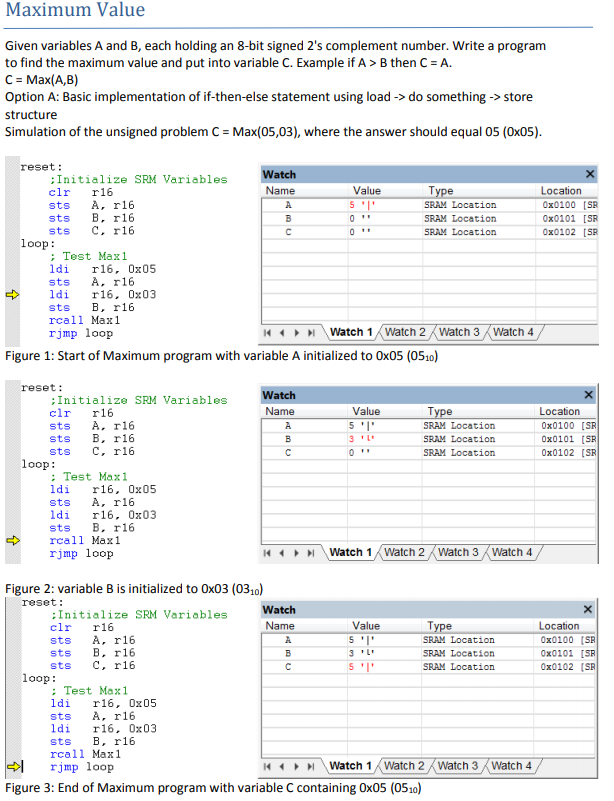
Solution Package
Option B: Bones implementation of if-and so-else statement. Structure modified to immediately
Solution
Code
/* Given variables A and B, each belongings an 8-chip signed 2'due south complement number, * write a program to notice the maximum value and put into variable C. For * instance if A > B so C = A. * * Solution B: Basic implementation of if-and so-else statement. * Structure modified to immediately store upshot. */ .INCLUDE .DSEG A: .BYTE ane B: .BYTE i C: .BYTE 1 .CSEG Max2: lds r16,A ; load lds r17,B cp r16,r17 brlt elseMax2 ; if (A >= B) sts C,r16 ; then C = A rjmp endMax2 elseMax2: sts C, r17 endMax2:
Simulation
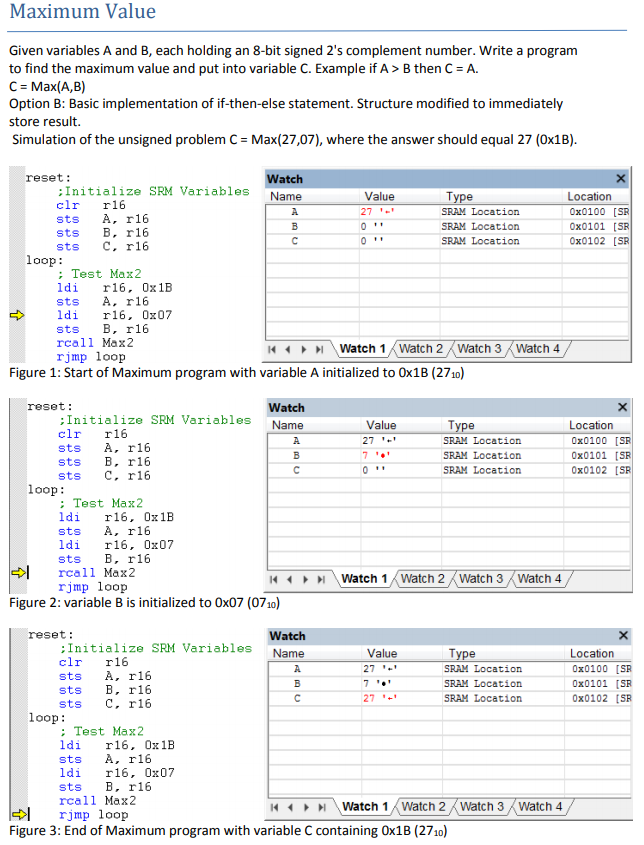
Solution Package
Choice C: If-then-else argument restructured to if-then with approximate. Result immediately stored in SRAM.
Solution
Code
/* Given variables A and B, each belongings an 8-bit signed 2's complement number, * write a programme to find the maximum value and put into variable C. * For example if A > B then C = A. * * Solution C: if-then-else statement restructured to if-so with guess * Issue immediately stored in SRAM. */ .INCLUDE .DSEG A: .BYTE 1 B: .BYTE ane C: .BYTE ane .CSEG Max3: lds r16, A ; load lds r17, B sts C, r16 ; estimate A > B cp r16, r17 brge endMax3 sts C, r17 endMax3: rjmp Max3
Simulation

Solution Packet
5) Given variable A holds an 8-bit signed 2's complement number. Write a program to discover the absolute value A. Salvage upshot back into variable A.
A = |A|
Solution
Code
/* Program 2 Given variable A holds an 8-scrap signed 2's complement number, * write a program to find the absolute value A. * Save issue back into variable A. * A = |A| */ .INCLUDE .DSEG A: .BYTE 1 .CSEG Absolute: lds r16, A ; load tst r16 ; if (A < 0) brpl endAbs neg r16 ; and so convert to a positive number endAbs: sts A, r16 ; store rjmp Absolute
Simulation
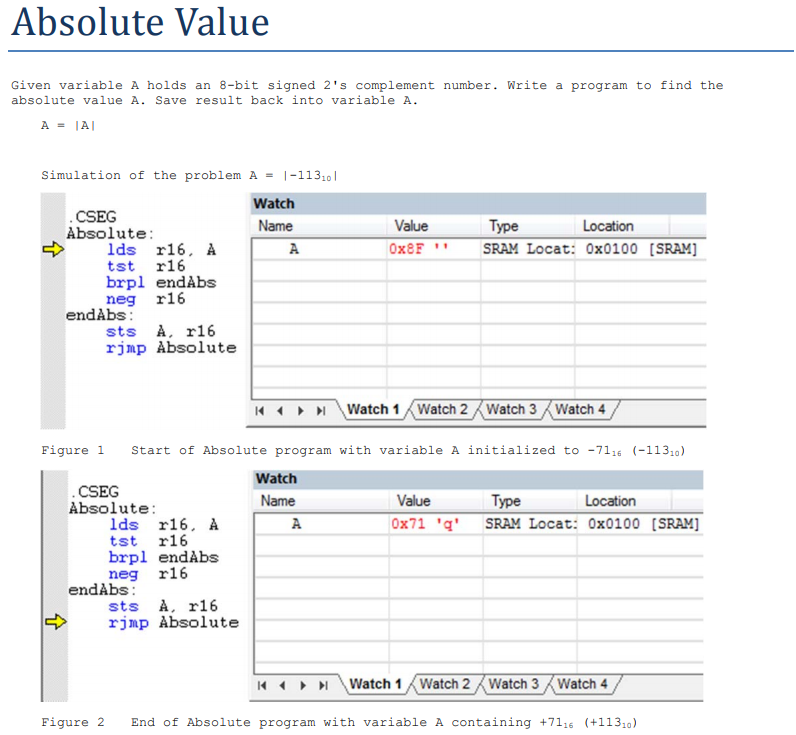
Solution Package
6) Write a program to add together viii chip variables A and B together. Store the sum into 8 scrap variable C. For this programming problem you may assume that the sum is less than 255 if A and B are unsigned and between -128 and 127 if signed.
C = A + B
Solution
Code
/* Write a programme to add 8 fleck variables A and B together, * and storing the sum into 8 bit variable C. * For this programming problem yous may assume that the sum is less * than 255 if A and B are unsigned and betwixt -128 and 127 if signed. * C = A + B */ .INCLUDE .DSEG A: .BYTE ane B: .BYTE 1 C: .BYTE i .CSEG Adder88: lds r0,A ; load lds r2,B add r0,r2 ; add sts C,r0 ; shop rjmp Adder88
Simulation
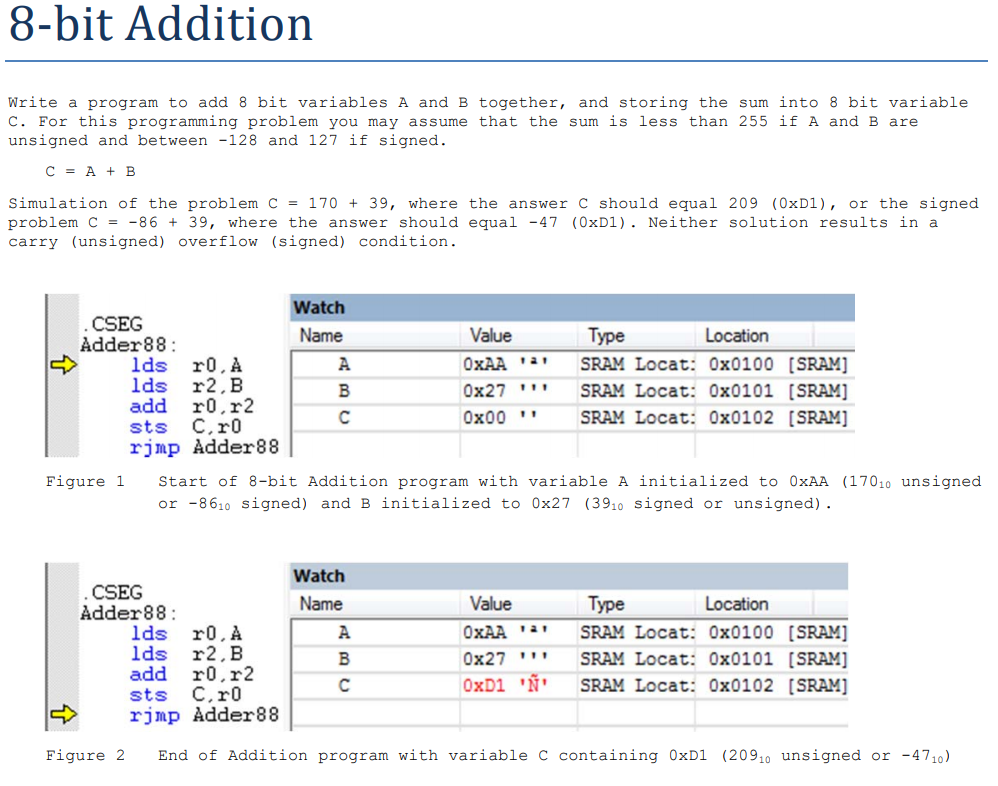
Solution Package
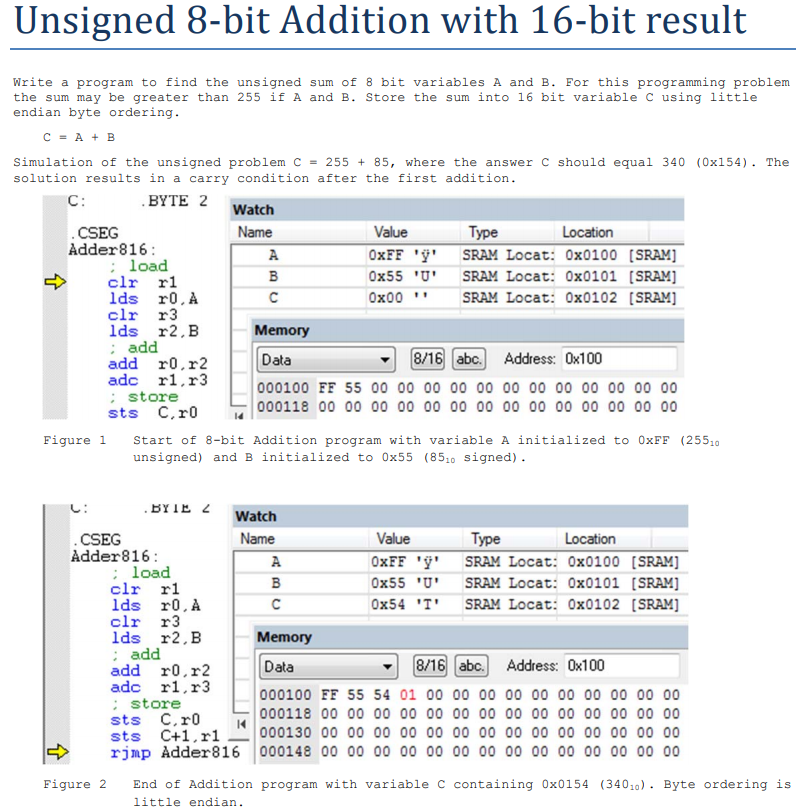
7) Write a programme to find the sum of unsigned 8 bit variables A and B. For this programming problem the sum may be greater than 255 if A and B. Store the sum into xvi chip variable C using little endian byte ordering.
C = A + B
Solution
Lawmaking
/* Write a programme to find the sum of 8 flake variables A and B. * For this programming problem the sum may be greater than 255 if A and B * are unsigned or less than -128 and greater than 127 if signed. * Store the sum into 16 scrap variable C using little endian byte ordering. * C = A + B */ .INCLUDE .DSEG A: .BYTE i B: .BYTE i C: .BYTE two .CSEG Adder816: ; load clr r1 ; r1:r0 = 0:A lds r0,A clr r3 ; r3:r2 = 0:B lds r2,B ; add together add together r0,r2 ; add together least significant bytes adc r1,r3 ; add with carry near pregnant bytes ; store sts C,r0 ; shop least pregnant byte first sts C+one,r1 rjmp Adder816
Simulation
Solution Parcel
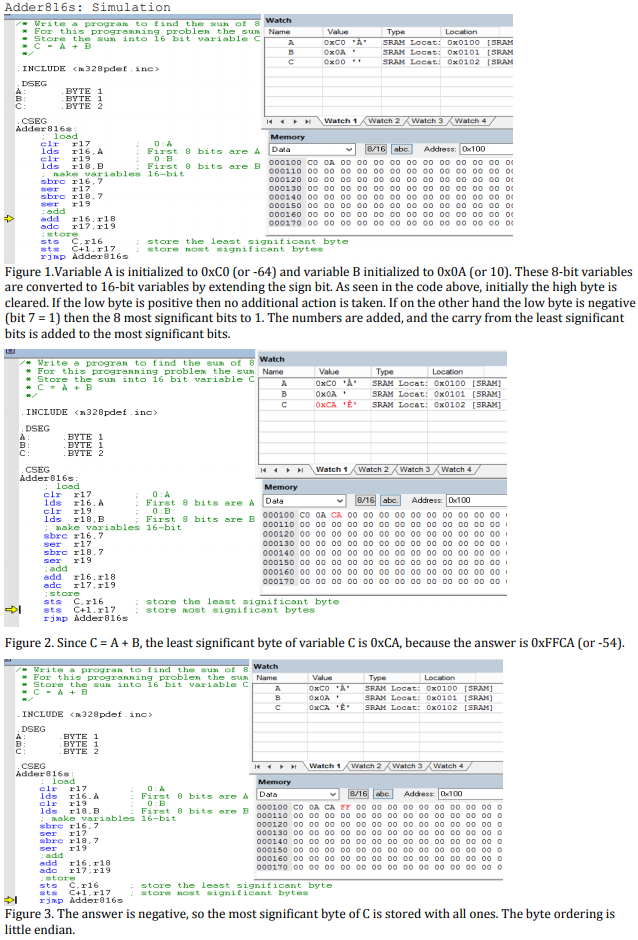
8) Write a plan to notice the sum of signed 8 fleck variables A and B. For this programming problem the sum may be less than -128 and greater than 127. Store the sum into 16 scrap variable C using little endian byte ordering.
C = A + B
Solution
Code
/* Write a program to discover the sum of 8 fleck variables A and B. * For this programming problem the sum may be less than -128 and greater than 127 * Shop the sum into sixteen bit variable C using fiddling endian byte ordering. * C = A + B */ .INCLUDE .DSEG A: .BYTE 1 B: .BYTE i C: .BYTE ii .CSEG Adder816s: ; load clr r17 ; 0:A lds r16,A ; Offset 8 bits are A clr r19 ; 0:B lds r18,B ; First 8 bits are B ; make variables 16-flake sbrc r16,7 ser r17 sbrc r18,7 ser r19 ;add add r16,r18 adc r17,r19 ;shop sts C,r16 ; store the least pregnant byte sts C+1,r17 ; store most pregnant bytes rjmp Adder816s
Simulation
Solution Package
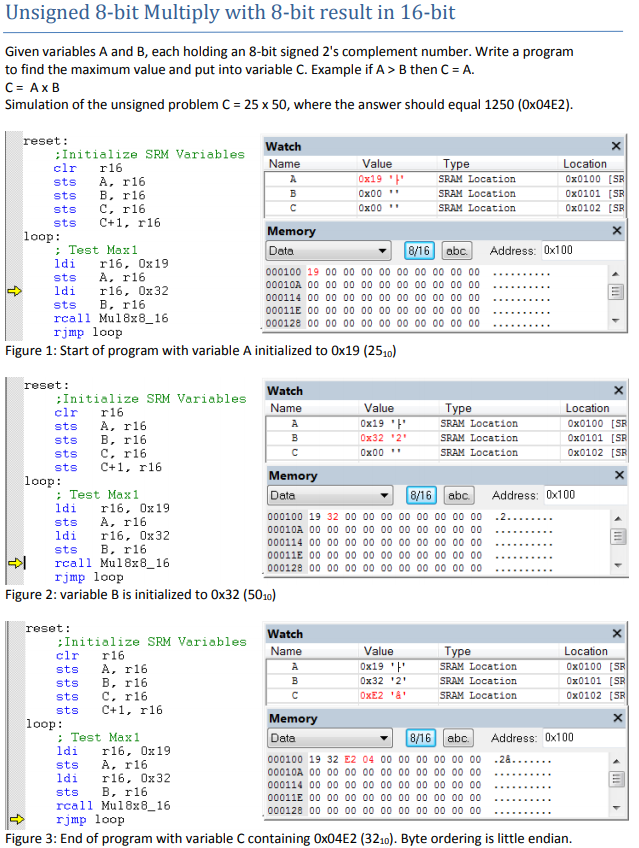
nine) Multiply eight-scrap unsigned variables A and B placing the product into 16-bit variable C. Salvage the 16-flake product using piddling endian byte ordering.
C = A x B
Solution
Lawmaking
/* Multiply eight-bit unsigned variables A and B placing * the product into 16-chip variable C. * Save the 16-bit production using little endian byte ordering. * C = A x B */ .INCLUDE .DSEG A: .BYTE i B: .BYTE one C: .BYTE 2 .CSEG Mul8x8_16: lds r16,A ; load lds r17,B mul r16,r17 sts C,r0 ; to the lowest degree significant byte (little terminate) sts C+1,r1 ; near significant byte (large end) rjmp Mul8x8_16
Simulation
Solution Package
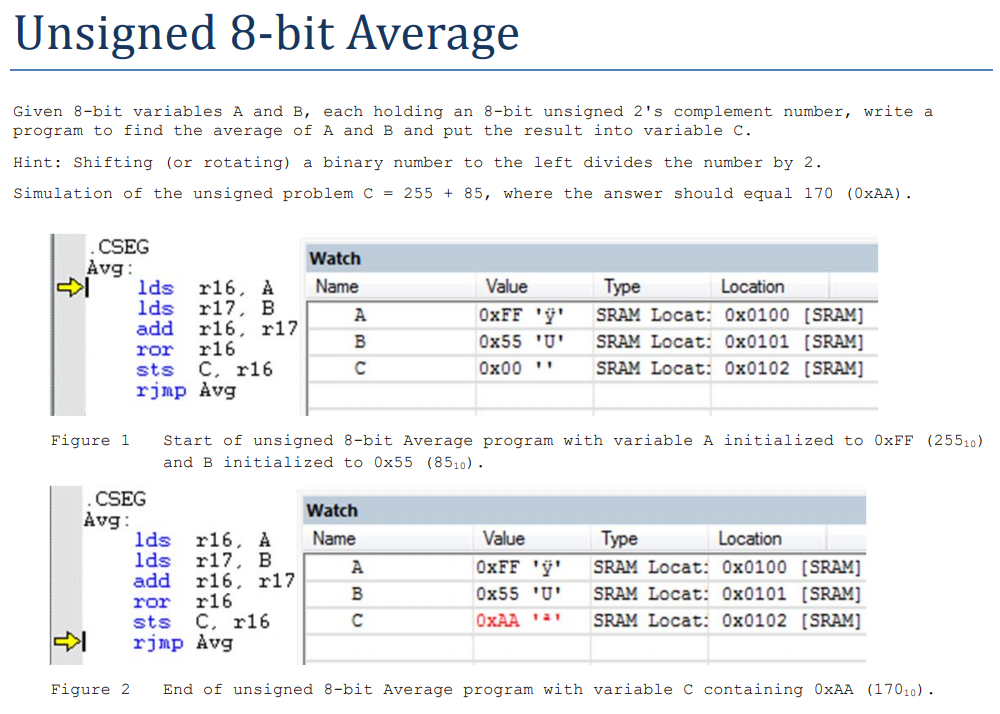
10) Given 8-fleck variables A and B, each holding an viii-fleck unsigned Write a plan to find the boilerplate of A and B. Place the upshot into variable C.
Hint: Shifting (or rotating) a binary number to the left divides the number by ii.
Solution
Lawmaking
/* Given viii-bit unsigned variables A and B, each holding an 8-flake signed 2's complement number, * write a program to observe the average of A and B and put the result into variable C. * Hint: Shifting (or rotating) a binary number to the left is equivalent to dividing by 2. */ .INCLUDE .DSEG A: .BYTE 1 B: .BYTE 1 C: .BYTE 1 .CSEG Avg: lds r16, A ; load lds r17, B add r16, r17 ; add ror r16 ; divide past 2 (include carry) sts C, r16 ; store rjmp Avg
Simulation
Solution Package
11) Given 8-bit variables A and B, each belongings an eight-bit signed 2's complement number. Write a program to find the boilerplate of A and B. Place the result into variable C.
Hint: Shifting (or rotating) a binary number to the left divides the number by 2.
Solution
Code
/* Given 8-chip variables A and B, each belongings * an eight-bit signed 2'southward complement number. Write * a programme to find the average of A and B. * Place the event into variable C. */ .INCLUDE .DSEG A: .BYTE 1 B: .BYTE i C: .BYTE two .CSEG ; inputs: viii-bit variables A and B ; output: 16-flake register C Avg8s: ; load registers A and B lds r24,A lds r26,B ; find average C = A+B/2 rcall Adder816s ; C=A+B ; divide by ii asr r25 ; least pregnant chip moved to carry fleck C ror r24 ; carry moves into most significant chip of r24 ; store the 8 bit outcome sts C,r24 clr r25 sts C+1,r25 rjmp Avg8s ; Add two 8-bit signed 2's complement numbers, ; where sum of A and B may be ix bits ; input: r24 and r26 are two 8-bit numbers ; output: register pair r25:r24 equals sum of r24 and r25 Adder816s: ; make variables sixteen-bit clr r25 ; guess r25 is positive 0x00:A sbrc r24,7 ; if number is positive guess is right so skip adjacent pedagogy ser r25 ; gauge incorrect, number is negative 0xFF:A clr r27 sbrc r26,7 ser r27 ;add add r24,r26 adc r25,r27 ;store sts C,r24 ; store the to the lowest degree meaning byte sts C+1,r25 ; shop virtually significant bytes ret
Simulation

Solution Package
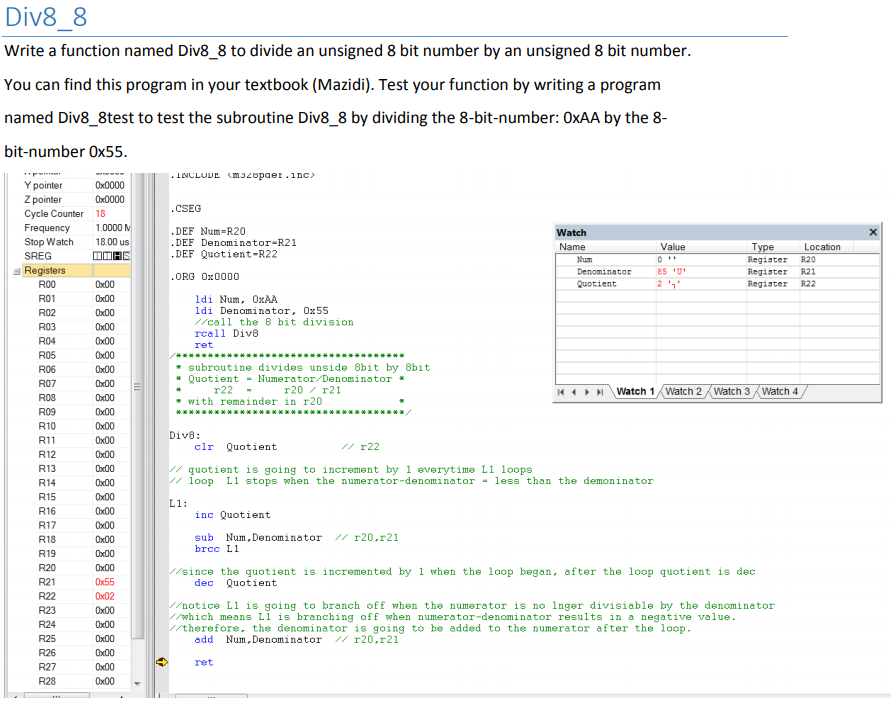
12) Write a function named Div8_8 to divide an unsigned 8 bit number by an unsigned 8 bit number. You tin find this program in your textbook (Mazidi). Test your function past writing a program named Div8_8test to test the subroutine Div8_8 past dividing the viii-bit-number: 0xAA past the 8-flake-number 0x55.
Solution
Code
; Div8_8 ; Version 1.0 ; Appointment: Nov 11, 2014 ; Written Past : Yoseph Yegezu ; From text book 'The AVR Microcontroller and Embedded systems'Chapter 5 Page 167 .INCLUDE .CSEG .DEF Num=R20 .DEF Denominator=R21 .DEF Quotient=R22 .ORG 0x0000 ldi Num, 0xAA ldi Denominator, 0x55 //call the 8 bit division rcall Div8 ret /************************************ * subroutine divides unside 8bit by 8bit * Quotient = Numerator/Denominator * * r22 = r20 / r21 * with residuum in r20 * ************************************/ Div8: clr Caliber // r22 // quotient is going to increment by 1 everytime L1 loops // loop L1 stops when the numerator-denominator = less than the demoninator L1: inc Quotient sub Num,Denominator // r20,r21 brcc L1 //since the quotient is incremented by 1 when the loop began, after the loop caliber is dec dec Quotient //discover L1 is going to branch off when the numerator is no lnger divisiable by the denominator //which means L1 is branching off when numerator-denominator results in a negative value. //therefore, the denominator is going to exist added to the numerator later the loop. add Num,Denominator // r20,r21 ret
Simulation
Solution Package
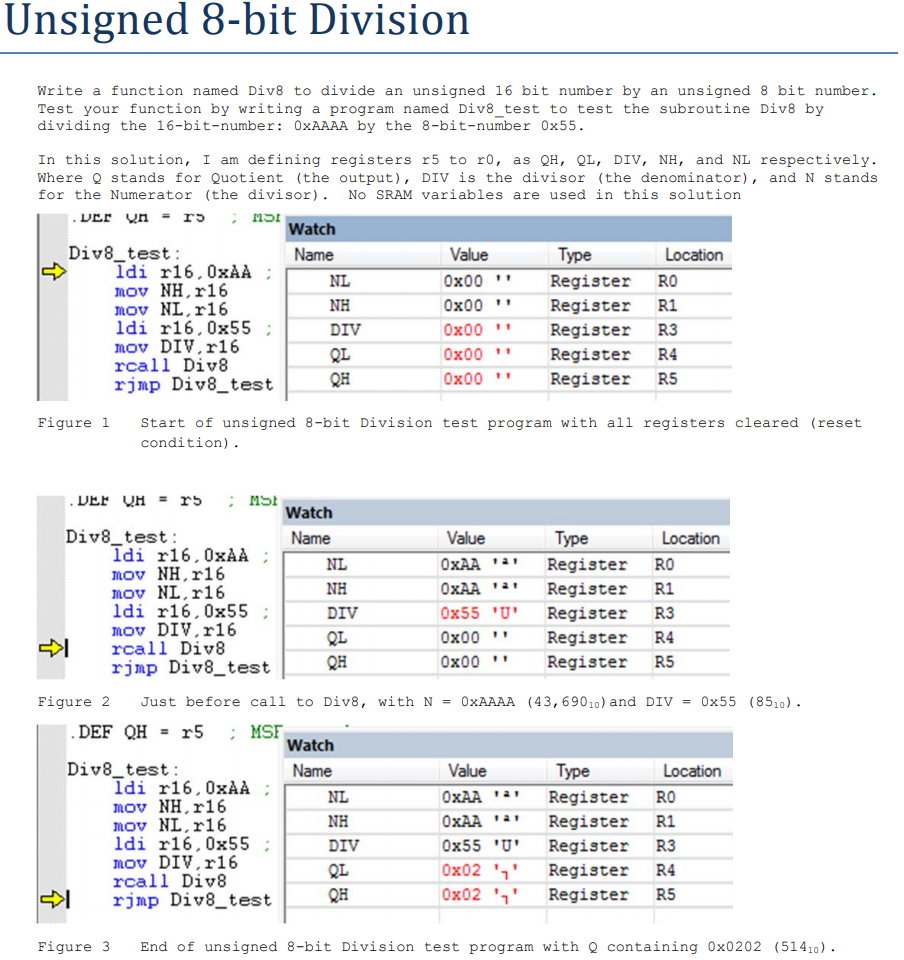
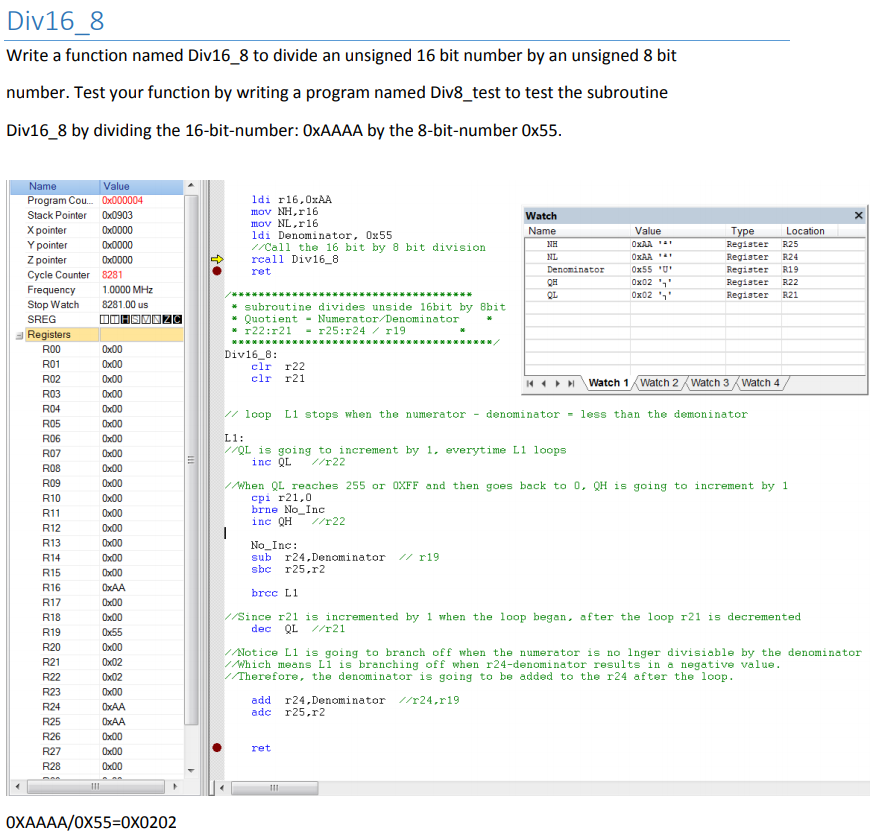
13) Write a part named Div16_8 to divide an unsigned 16 scrap number by an unsigned 8 bit number. Test your function by writing a program named Div8_test to test the subroutine Div16_8 by dividing the sixteen-fleck-number: 0xAAAA by the 8-bit-number 0x55.
Choice A
Solution
Code
/* * Write a subroutine named Div8 to divide a 16-bit number by an eight-scrap number. * Next, write a program named Div8_test to test the subroutine Div8 * past dividing the 16-chip-number: 0xAAAA by the 8-fleck-number 0x55 * * Q = North/D Split a xvi-bit-number NH:NL by an 8-bit-number Q * * Source: * one. Binary division in AVR Assembler * http://www.avr-asm-tutorial.internet/avr_en/calc/DIVISION.html * 2. Integer division (unsigned) with remainder * http://en.wikipedia.org/wiki/Division_algorithm */ .DEF NL = r0 ; LSB sixteen-chip-number to be divided .DEF NH = r1 ; MSB 16-fleck-number to be divided .DEF DIV = r3 ; 8-bit-number to carve up with .DEF QL = r4 ; LSB result .DEF QH = r5 ; MSB result Div8_test: ldi r16,0xAA ; 0xAAAA to be divided mov NH,r16 mov NL,r16 ldi r16,0x55 ; 0x55 to be divided with mov DIV,r16 rcall Div8 rjmp Div8_test /* Div8 * Q = N/D Divide a 16-chip-number NH:NL by an viii-flake-number Q * input * N = Numerator (dividend) * D = Denominator (divisor) * output * Q = Quotient */ Div8: push r0 push r1 push button r2 clr r2 ; articulate interim register clr QH ; QH:QL = 0b0000 0000 0000 0001 clr QL inc QL div8a: ; kickoff of the segmentation loop clc ; clear carry-scrap rol NL ; rotate the adjacent-upper flake of the numerator rol NH ; to the acting register (multiply by 2) rol r2 brcs div8b ; a one has rolled left, and so subtract cp r2,DIV ; Sectionalisation result 1 or 0? brcs div8c ; bound over subtraction, if smaller div8b: sub r2,DIV ; decrease number to split up with sec ; set conduct-bit, result is a 1 rjmp div8d ; bound to shift of the result bit div8c: clc ; clear carry-bit, resulting scrap is a 0 div8d: rol QL ; rotate comport-flake into issue registers rol QH brcc div8a ; as long as zero rotate out of the result ; registers QH:QL go on with the division loop pop r2 pop r1 pop r0 ret ; Terminate of the partitioning reached program8:
Simulation
Solution Package
Pick B
This solution is an extension of Div8_8
Solution
Code
; Div16_8B ; Version 1.0 ; Date: November 11, 2014 ; Written By : Yoseph Yegezu .INCLUDE .CSEG .DEF Denominator=R19 .DEF NL=r24 .DEF NH=r25 .DEF QL=r21 .DEF QH=r22 .ORG 0x0000 ldi r16,0xAA mov NH,r16 mov NL,r16 ldi Denominator, 0x55 //Call the xvi chip by 8 flake division rcall Div16_8 ret /************************************ * subroutine divides unside 16bit by 8bit * Quotient = Numerator/Denominator * * r22:r21 = r25:r24 / r19 * ***************************************/ Div16_8: clr r22 clr r21 // loop L1 stops when the numerator - denominator = less than the demoninator L1: //QL is going to increment past 1, everytime L1 loops inc QL //r22 //When QL reaches 255 or 0XFF then goes back to 0, QH is going to increment past 1 cpi r21,0 brne No_Inc inc QH //r22 No_Inc: sub r24,Denominator // r19 sbc r25,r2 brcc L1 //Since r21 is incremented by ane when the loop began, afterward the loop r21 is decremented december QL //r21 //Discover L1 is going to branch off when the numerator is no lnger divisiable past the denominator //Which means L1 is branching off when r24-denominator results in a negative value. //Therefore, the denominator is going to be added to the r24 after the loop. add r24,Denominator //r24,r19 adc r25,r2 ret
Simulation
Solution Package
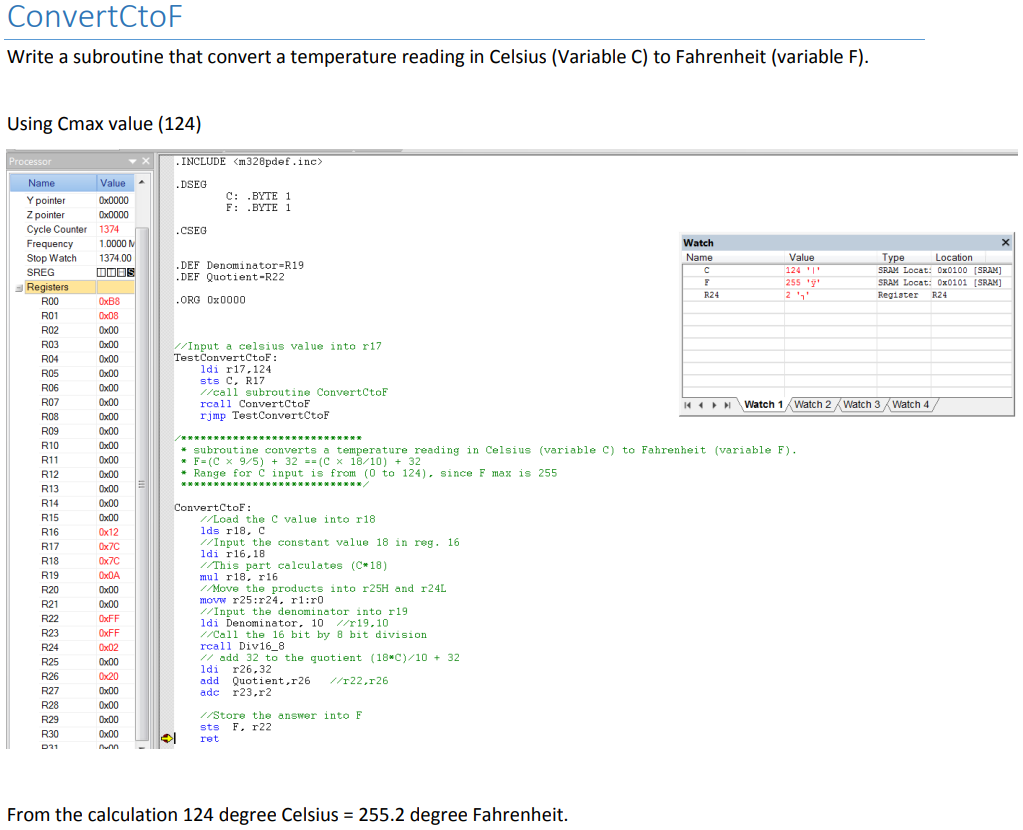
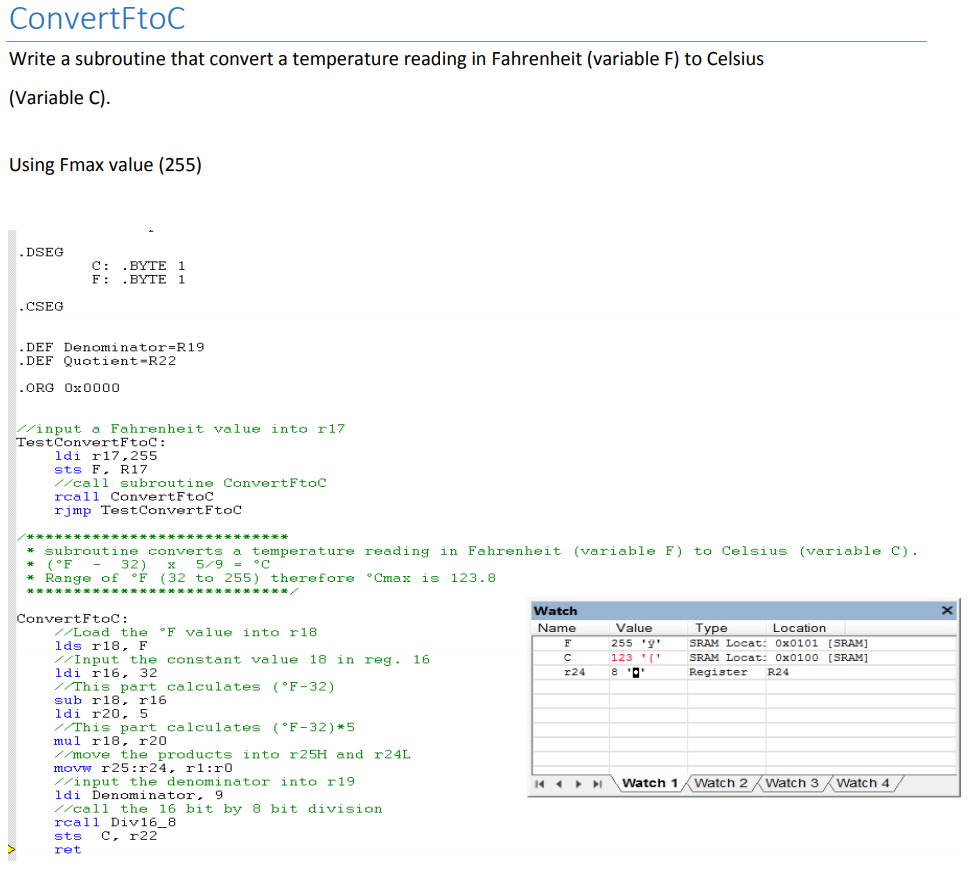
14) Write a subroutine that catechumen a temperature reading in Fahrenheit (variable F)to Celsius (variable C).
Solution
Code
; ConvertCtoF ; Version one.0 ; Date: November eleven, 2014 ; Written By : Yoseph Yegezu .INCLUDE .DSEG C: .BYTE 1 F: .BYTE ane .CSEG .DEF Denominator=R19 .DEF Caliber=R22 .ORG 0x0000 //Input a celsius value into r17 TestConvertCtoF: ldi r17,74 sts C, R17 //call subroutine ConvertCtoF rcall ConvertCtoF rjmp TestConvertCtoF /**************************** * subroutine converts a temperature reading in Celsius (variable C) to Fahrenheit (variable F). * F=(C × 9/5) + 32 ==(C × 18/10) + 32 * Range for C input is from (0 to 124), since F max is 255 ****************************/ ConvertCtoF: //Load the C value into r18 lds r18, C //Input the constant value xviii in reg. 16 ldi r16,xviii //This part calculates (C*18) mul r18, r16 //Move the products into r25H and r24L movw r25:r24, r1:r0 //Input the denominator into r19 ldi Denominator, ten //r19,ten //Telephone call the xvi scrap by 8 bit sectionalisation rcall Div16_8 // add 32 to the quotient (xviii*C)/10 + 32 ldi r26,32 add Caliber,r26 //r22,r26 adc r23,r2 //Store the answer into F sts F, r22 ret /************************************ * Quotient = Numerator/Denominator * * r23:r22 = r25:r24 / r19 * r24 = remainder * ************************************/ Div16_8: clr r2 clr r23 clr Quotient // r22 // quotient is going to increment by 1 every fourth dimension L1 loops // loop L1 stops when the numerator-denominator is less than the demoninator(10) //(eighteen*C)/10 L1: inc Caliber adc r23,r2 sub r24,Denominator // r24,r19 sbc r25,r2 brcc L1 //since the quotient is incremented by 1 when the loop began, after the loop quotient is december dec Quotient sbc r23,r2 //notice L1 is going to co-operative off when the numerator is no lnger divisiable by the denominator. //which means L1 is branching off when r24-denominator results in a negative value. //therefore, the denominator is going to be added to the r24 after the loop. add r24,Denominator adc r25,r2 ret
Simulation
Solution Package
15) Write a subroutine that catechumen a temperature reading in Celsius (variable C) to Fahrenheit (variable F).
Solution
Lawmaking
; ConvertFtoC ; Version 1.0 ; Date: November 11, 2014 ; Written By : Yoseph Yegezu .INCLUDE .DSEG C: .BYTE 1 F: .BYTE 1 .CSEG .DEF Denominator=R19 .DEF Quotient=R22 .ORG 0x0000 // Input a Fahrenheit value into r17 TestConvertFtoC: ldi r17,124 sts F, R17 // Call subroutine ConvertFtoC rcall ConvertFtoC rjmp TestConvertFtoC /**************************** * Subroutine converts a temperature reading in Fahrenheit (variable F) to Celsius (variable C). * (F - 32) 10 5/9 = C * Range of F (32 to 255) therefore Cmax is 123.viii ****************************/ ConvertFtoC: //Load the F value into r18 lds r18, F //Input the constant value eighteen in reg. sixteen ldi r16, 32 //This part calculates (°F-32) sub r18, r16 ldi r20, 5 //This function calculates (°F-32)*five mul r18, r20 //Move the products into r25H and r24L movw r25:r24, r1:r0 //Input the denominator into r19 ldi Denominator, 9 //Call the 16 fleck by 8 bit segmentation rcall Div16_8 sts C, r22 ret /************************************ * Quotient = Numerator/Denominator * * r23:r22 = r25:r24 / r19 * ************************************/ Div16_8: clr r2 clr r23 clr Caliber // r22 // Quotient is going to increment past one everytime L1 loops // Loop L1 stops when the numerator-denominator = less than 10(the demoninator) // This role calculates (°F-32)*5/9 L1: inc Quotient adc r23,r2 sub r24,Denominator // r19 sbc r25,r2 brcc L1 // Since the quotient is incremented by i when the loop began, after the loop caliber is december dec Quotient sbc r23,r2 // Notice L1 is going to branch off when the numerator is no lnger divisiable by the denominator. // Which ways L1 is branching off when r24-denominator results in a negative value. // Therefore, the denominator is going to be added to the r24 after the loop. add r24,Denominator adc r25,r2 ret
Simulation
Solution Package
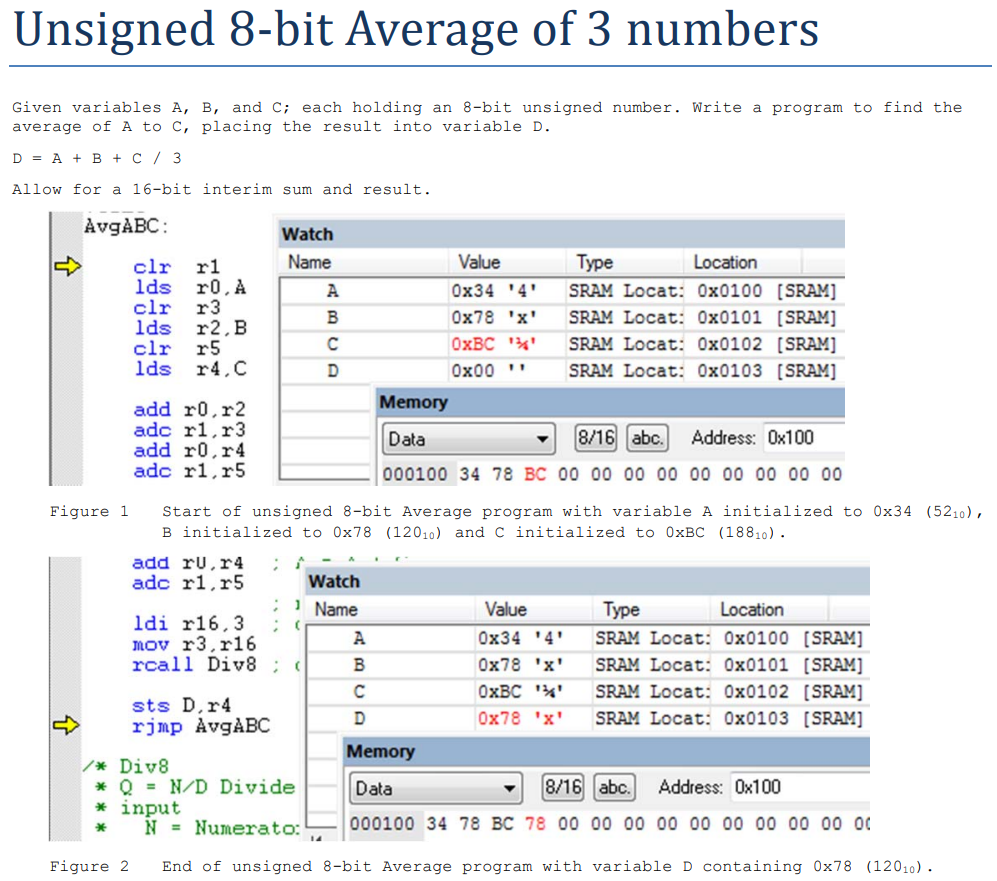
sixteen) Given variables A, B, and C; each holding an 8-chip unsigned number. Write a program to find the average of A to C, placing the result into variable D.
D = A + B + C / 3
Allow for a 16-bit interim sum and consequence.
Solution
Code
/* Given variables A, B and C, each holding an eight-bit signed 2's complement number, * write a plan to find the average of A to C, placing the result into variable D. * D = A + B + C / 3 * Permit for a xvi-bit interim sum and event. * Tip: Copy and paste Div8 subroutine into the AvgABC.asm program. */ .INCLUDE .DSEG A: .BYTE 1 B: .BYTE 1 C: .BYTE 1 D: .BYTE 2 .CSEG Setup: ldi r16, 0x34 ; 52 variable default values sts A, r16 ldi r16, 0x78 ; 120 sts B, r16 ldi r16, 0xBC ; 188 sts C, r16 ; sum = 0x168 (360), average = 0x78 (120) AvgABC: ; load clr r1 ; r1:r0 = 0:C lds r0,A clr r3 ; r3:r2 = 0:B lds r2,B clr r5 ; r5:r4 = 0:A lds r4,C add r0,r2 ; A = A + B adc r1,r3 add r0,r4 ; A = A + C adc r1,r5 ; numerator r1:r0 = A + B + C ldi r16,3 ; divisor /r2 = /3 mov r3,r16 rcall Div8 ; quotient r4:r3 = r1:r0 / r2 sts D,r4 rjmp AvgABC /* Div8 * Q = Northward/D Separate a 16-fleck-number NH:NL past an viii-bit-number Q * input * N = Numerator (dividend) * D = Denominator (divisor) * output * Q = Quotient */ .DEF NL = r0 ; LSB 16-bit-number to exist divided .DEF NH = r1 ; MSB sixteen-scrap-number to be divided .DEF DIV = r3 ; 8-bit-number to split up with .DEF QL = r4 ; LSB result .DEF QH = r5 ; MSB result Div8: push r0 push r1 push button r2 clr r2 ; clear interim register clr QH ; QH:QL = 0b0000 0000 0000 0001 clr QL inc QL div8a: ; start of the partition loop clc ; clear carry-scrap rol NL ; rotate the next-upper chip of the numerator rol NH ; to the acting register (multiply by 2) rol r2 brcs div8b ; a i has rolled left, then subtract cp r2,DIV ; Division issue 1 or 0? brcs div8c ; bound over subtraction, if smaller div8b: sub r2,DIV ; subtract number to divide with sec ; prepare behave-bit, issue is a 1 rjmp div8d ; jump to shift of the result fleck div8c: clc ; clear behave-scrap, resulting bit is a 0 div8d: rol QL ; rotate carry-bit into issue registers rol QH brcc div8a ; as long equally zero rotate out of the result ; registers QH:QL become on with the partitioning loop pop r2 pop r1 pop r0 ret ; End of the sectionalization reached
Simulation
Solution Package
More than Bug to be added…
Practice Bug: Interrupts
- Initialize Interrupt 1 (INT1) pin to generate an Interrupt on a ascension edge. Set all unused bits to default values.
_____ R16, 0x____
_____ EICRA, R16 - Initialize Interrupt 0 (INT0) pin to generate an Interrupt on a falling edge. Exercise not change the other bits (ISC11, ISC10) in the External Interrupt Control Annals A (EICRA). You should assume the previous code (problem 1) has been written (i.e., bits 1 and 0 cleared)
_____ R16, EICRA
_____ R16, 0x____
_____ EICRA, R16 - Configure Pin 15 PB1 (OC1A/PCINT1) to generate an Interrupt whenever the pin changes state. Do non alter whatsoever other bits. To make things more interesting, do not use the SBR instruction.
_____ R16, PCMSK0 ; load
_____ R17, PCICR
_____ R18, SREG
_____ R16, 0x ; do something
_____ R17, 0x____
_____ R18, 0x____
_____ PCMSK0, R16 ; store
_____ PCICR, R17
_____ SREG, R18
hartlinebusbashem.blogspot.com
Source: https://www.arxterra.com/classes/intro-to-arduino-assembly/programming-problems/
0 Response to "How to Read Value in Assembly Arduino"
Post a Comment