Your Case Is in Line to Be Reviewed by an Officer Iran

Take a closer await at how the IRS Independent Office of Appeals works with taxpayers who disagree with an IRS determination.
Go to know the IRS, its people and the issues that affect taxpayers

By Andy Keyso
CL-21-12, Apr 8, 2021
While some other articles for A Closer Look have focused on compliance activities (such equally audits or collection deportment) that the IRS takes to ensure taxpayers adhere to the federal tax laws, information technology's important to remember that the tax law is complex, and even though IRS employees making compliance determinations are jump to apply the tax constabulary adequately to all taxpayers, it's not unusual for a taxpayer and the IRS to disagree about the proper awarding of the law to the taxpayer's personal state of affairs. Where does a taxpayer turn when such a disagreement exists? Must the taxpayer challenge the IRS'southward conclusion in court?
As Chief of the Independent Part of Appeals, I'd like to remind taxpayers that they can have their case reviewed past an Appeals Officer who is contained of the IRS compliance function that made the initial determination in their case. I'1000 a large laic in a strong appeals function within the IRS. During my 30 years with the Internal Revenue Service, I've had the privilege to experience the tax organisation from a variety of perspectives. I spent 7 years auditing and reviewing audits of taxpayers' income tax returns, and some other eighteen years in the Part of Chief Counsel interpreting the constabulary and applying information technology to specific taxpayer situations. I've seen firsthand how complex law or unique facts tin lead to uncertainty in how the police force applies to the taxpayer. I've as well seen how taxpayers who are unfamiliar with the revenue enhancement system may be unaware of their right to seek a review of an examination or collection action. Informed past these experiences, I joined the Independent Office of Appeals in 2017, and now atomic number 82 a grouping of Appeals employees dedicated to ensuring that taxpayers receive an contained and impartial "2d wait" at their disputes with the IRS. Read on, and I'll introduce you lot to the Contained Office of Appeals and explain how to appeal an IRS determination and what to expect when your case comes to Appeals.
Our Function
Appeals is an independent function within the IRS, completely separate from the compliance functions responsible for collecting and assessing taxes. Appeals provides an informal forum for taxpayers who disagree with an IRS conclusion. Our job is to resolve tax disputes without litigation, where possible, consider each example fairly and impartially and improve public confidence in the integrity and efficiency of the IRS.
Nosotros do this past listening to taxpayers, understanding both sides (taxpayers and IRS compliance), independently evaluating all arguments and available data and identifying appropriate settlement options. We have an overall staff of approximately 1,240 employees, mostly Appeals Officers and Settlement Officers. An Appeals Officeholder typically handles matters involving audit-related problems similar penalties or additions to tax. For some complex matters, Appeals Officers may work as a team with other Appeals Officers. A Settlement Officeholder typically handles matters involving collection matters similar whether the IRS followed proper procedures when imposing a lien or proposing a levy for unpaid taxes.
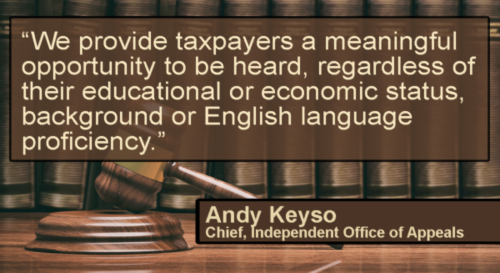
In Appeals, we work with taxpayers informally to settle revenue enhancement disputes without a formal court hearing and, in most cases, without the need to hire someone to represent them. We provide taxpayers a meaningful opportunity to be heard, regardless of their educational or economic status, background or English language proficiency. In fact, the Taxpayer Showtime Act of 2019 gives taxpayers the correct to come to Appeals to dispute most IRS Compliance determinations.
Appeals is unique within tax administration, considering we have the authority to compromise the amount of tax owed to resolve a dispute. This means Appeals can offer taxpayers a fair settlement based on the likely upshot if their example were to become to courtroom. We refer to this as evaluating the "hazards of litigation." Here, I should note that not every dispute merits a compromise and some bug do non heighten hazards of litigation. Appeals Officers and Settlement Officers are trained to carefully review the facts and law of each case to reach an impartial and fair settlement. Yous can better the risk of a favorable settlement by providing every bit much show and supporting documentation equally possible with your case. Though non required, taxpayers may have a representative handle their example. Taxpayers who are unable to pay a representative may be eligible for help for gratis through a Low Income Tax DispensaryPDF.
How to Request an Appeal
Typically, appeal rights become available following a compliance action past IRS that could include an audit, penalty cess or notice of a collection action. If y'all receive an IRS notice and your case is eligible for an appeal, the notice will explain your appeal rights. At that signal, if you disagree with the IRS determination, you can request an entreatment. The next step is to write down, either in a formal protest or simple statement, the problems with which y'all disagree and why. Y'all tin can find out more about how to request an appeal and where to send information technology on IRS.gov. It's important to remember that you lot should make your appeal request with the IRS compliance person who worked your case. That employee then will be able to send your appeal request, along with your case file, to Appeals. Taxpayers tin can also come to appeals after filing a petition in the United States Tax Courtroom to dispute the IRS compliance action.
The Appeals Process
Once your example arrives in Appeals, we will assign information technology to an Appeals Officer or Settlement Officer depending on the type of example. Our goal is to have the assigned Appeals employee contact y'all by mail or phone within approximately 30 days of receiving your case; however, it is taking longer these days due to pandemic-related delays and other resources constraints. If y'all have made an Appeals request and feel an unreasonable corporeality of fourth dimension has passed, you tin can read more well-nigh how to check on the status of your appeal in the frequently asked questions (FAQs) under what to expect from appeals.
To evaluate your instance, the Appeals Officer will fully consider your position and arguments along with the administrative case file from the IRS compliance person who worked your case. You may request to view the not-privileged part of the Compliance file prior to meeting with Appeals. One of the nigh helpful things y'all tin do is provide all relevant facts, documents and other data supporting your position to the IRS compliance person working your example earlier it comes to Appeals. If you are unable to locate an important certificate that might help explain your position, please try to explain the document, why it isn't available and what steps you took to effort to obtain copies, etc. In this way, Appeals will take available all the information necessary to fully review your instance. Appeals Officers and Settlement Officers try to resolve cases afterward property a taxpayer briefing or by correspondence. But, some complex cases may take more than than ane conference to resolve.
During your appeal, the Appeals Officeholder or Settlement Officer will discuss with you the facts of your case and how the police force applies to these facts. Sometimes the facts and tax law are quite apparent. In other cases, the facts may be difficult to necktie down or the law may exist subject to multiple interpretations. When faced with this type of uncertainty, the Appeals Officer may review court decisions to see how the courts have ruled in similar situations. As mentioned earlier, Appeals may also consider the "hazards of litigation" or the likely outcome if your case were to become to court.
The scope and nature of our review depends on the type of case. But in all cases, the Appeals Officer or Settlement Officeholder will listen to your concerns and review any data or comments you lot nowadays earlier making a final determination. If your example results in a decision y'all experience is unfavorable, we will explain the reasons for our decision and any additional options you may have. If you concur to settle your example in Appeals, we may provide you with an agreement form to sign. If you are unable to settle your case in Appeals, you may exist entitled to dispute the IRS conclusion in the Tax Courtroom or another Federal court.
The time it takes for Appeals to work your case depends on several factors, including the blazon of case, the facts of the instance, the complexity of the issues, the availability of legal precedents, other legal theories involved and Appeals' determination of the hazards of litigation. If you have petitioned the Tax Court prior to coming to Appeals, you take a "docketed" case and the fourth dimension involved will as well be afflicted by dates and timeframes established past the court and across Appeals' ability to control. Cases received directly from a compliance function that have not been petitioned to the Taxation Courtroom are referred to as "non-docketed" cases. Recently, for non-docketed exam or drove appeals, the entire procedure, from the time your case is received in Appeals to the time information technology is resolved or closed in Appeals, takes on average seven or 8 months.
Taxpayers Come First
In Appeals, we are always focused on improving taxpayers' experience. Improving the taxpayer experience ways ensuring all taxpayers take convenient access to a meaningful and timely appeal. To achieve this goal, we are:
- Increasing our staffing.
- Adopting secure digital messaging to communicate with taxpayers electronically.
- Expanding taxpayer admission to videoconferences so they can meet with us "face-to-face" even during the pandemic.
- Expanding internal paperless processes to allow usa to procedure cases more quickly.
In response to the COVID-19 pandemic, Appeals accelerated a number of these initiatives. Appeals employees adapted quickly and admirably to the changed circumstances. I am securely grateful for their hard work, which allowed u.s.a. to keep providing summit-quality service without pause.
Last Thoughts
I am proud of the work we practise and heartened by the professionalism and commitment of my Appeals' colleagues, who, like about Americans, have overcome many personal and professional challenges over the past year. In coming months, nosotros volition build on recent improvements and lessons learned from the pandemic to better come across taxpayers' expectations.
The Appeals process is designed to exist informal and easy to navigate. Notwithstanding, I know information technology tin can be a lilliputian scary to deal with whatsoever regime arrangement. Hopefully, Appeals' independence, quality decision-making and streamlined processes keep to encourage taxpayers to invest the fourth dimension and resource needed to reach settlements with the IRS. And, my hope is this closer look at Appeals will aid you lot improve empathise how Appeals tin can assist you resolve a taxation dispute without litigation.
Andy Keyso
Master, Contained Office of Appeals
hartlinebusbashem.blogspot.com
Source: https://www.irs.gov/about-irs/a-closer-look-at-the-irs-independent-office-of-appeals
0 Response to "Your Case Is in Line to Be Reviewed by an Officer Iran"
Post a Comment