what are the pros and cons of a rebreather compared to open circuit
Recreational scuba divers dive using a regulator and they are classified equally open-circuit. However, more advanced divers often switch to a dissimilar animate appliance known every bit a closed-circuit rebreather (CCR) or merely a rebreather. While regulators are the more mutual breathing apparatus, perhaps one 24-hour interval you will accelerate to a rebreather and would similar to know the differences betwixt the ii. In this commodity, we'll look at the benefits of open up-circuit and closed-circuit diving and how these two differ.
Contents
- What is open up-circuit diving? (Diving with a regulator)
- What is closed-excursion diving? (Diving a rebreather, CCR)
- Mouthpiece
- Hoses
- Carbon Dioxide Scrubber
- Counterlungs
- Over-Pressure Valve
- Gas Tank
- Benefits of open-circuit diving
- Benefits of closed-circuit diving
- Are rebreathers dangerous?
- Certifications
- Parting words
What is open-circuit diving? (Diving with a regulator)
Virtually recreational diving is open-circuit, pregnant it involves using a regulator. A very bones gas mixture used consists of 21% oxygen, 78% nitrogen, and 1% various gases like argon. For nitrox diving, gas mixtures consisting of more than than 21% oxygen volition be used. Regardless of what gas mixture they use, in open up-circuit diving none of the gas that is exhaled is recycled.
Have yous ever noticed how when you exhale with a regulator, bubbles come out of the exhaust? That'due south because the gas isn't recycled or reused in open-circuit diving. The gas is stored in the tank, travels through the regulator and into the lungs, so it is exhaled into the surrounding sea. The exception is when you lot're wearing a buoyancy control device (BCD), in which case the gas may pass to the BCD to improve buoyancy.
To sum it upwards, the defining feature of open-circuit diving is that the breathing gas is non reused or recycled. Afterwards the gas goes from the tank to your lungs and you exhale, information technology'southward but released into the sea or transferred to your BCD.
What is closed-circuit diving? (Diving a rebreather, CCR)
In a fully closed-circuit rebreather, a pocket-sized tank of mixed gases (oxygen and nitrogen or oxygen and helium) or pure oxygen volition exist injected into your animate loop. No gas ever leaves the system, hence it is fully-airtight.
In a semi-airtight excursion rebreather, only some of the gases you lot exhale are reused and replaced with fresh breathing gas (oxygen, nitrox, or trimix) that is injected into the breathing loop. The rest are released. The do good of a semi-closed circuit rebreather is that the setup is much simpler. The downside is that it may lack gas monitoring capabilities and increase the run a risk of something going incorrect.
Airtight-circuit diving involves the employ of a rebreather, plus some other equipment, which partially or completely recycles all of the breathing gas. They let you to swoop using smaller gas tanks which decreases majority and drag.
Rebreathers, like open-circuit regulators, as well have a mouthpiece which you inhale and exhale through while underwater. When you lot inhale, the gas will be transferred from the tank and depressurized so that it'south safe to breathe.
Where airtight-circuit rebreathers differ from open-excursion regulators is when you exhale. The gas doesn't get sent out to the body of water; instead, it gets cleaned and sent back to the tank so that it can be reused. Get why it's called a rebreather now?
A rebreather is non but a mouthpiece, and we drastically simplified the part where the gas goes from your lungs dorsum to the tank. As we mentioned, the air must be cleaned upward first. There is an entire arrangement with many components which makes this possible. Specifically, one of the components is the carbon dioxide scrubber which removes the carbon dioxide from the gas and then sends the air to the counterlungs.
Below, we go over each component that comprises the rebreather.
Mouthpiece
A mouthpiece is, of course, still necessary for CCR diving. It is the component which yous inhale and exhale through. Like whatever other mouthpiece, y'all hold it in place by bitter down on the top and lesser with your teeth. You need to make sure the fit is good, otherwise it will crusade jaw fatigue and hurting.
Hoses
At that place are several hoses which provide the diver with gas when they inhale, and recycle the diver's used gas when they breathe. They are generally constructed from flexible and durable synthetic rubber. Rebreather hoses attach the mouthpiece to other components such as the counterlungs and gas tank.
Carbon Dioxide Scrubber
As nosotros mentioned previously, the carbon dioxide scrubber is an essential component of the rebreather that removes the carbon dioxide from the gas that leaves the diver's lungs. When y'all exhale, the exhaled gas volition have less oxygen than when you inhaled and more carbon dioxide.
If we tried animate that again under normal circumstances, we'd be breathing in a lot of carbon dioxide instead of oxygen and we'd suffocate. The carbon dioxide scrubber will remove the carbon dioxide from this air before sending it to the counterlungs.
Counterlungs
Even so some other essential component of the rebreather is the counterlungs. This component helps defined breathe gas by maintaining the same pressure every bit the diver's lungs (tidal book).
Over-Pressure Valve
Not all rebreathers have this component, however some of them volition come up with an over-pressure valve. This component is mounted on the counterlungs and allows the diver to release some gas from the animate excursion during the ascent. If the gas is non let out during an ascent, then the trapped gas will aggrandize and potentially cause a critical equipment failure.
Gas Tank
Lastly, all rebreathers take a gas tank where the breathing gas is stored and recycled back into. The defining characteristic of closed-excursion diving is that the gas is fully or at least partially recycled. On the other hand, open-excursion regulators do not recycle the breathing gas.
Benefits of open up-circuit diving
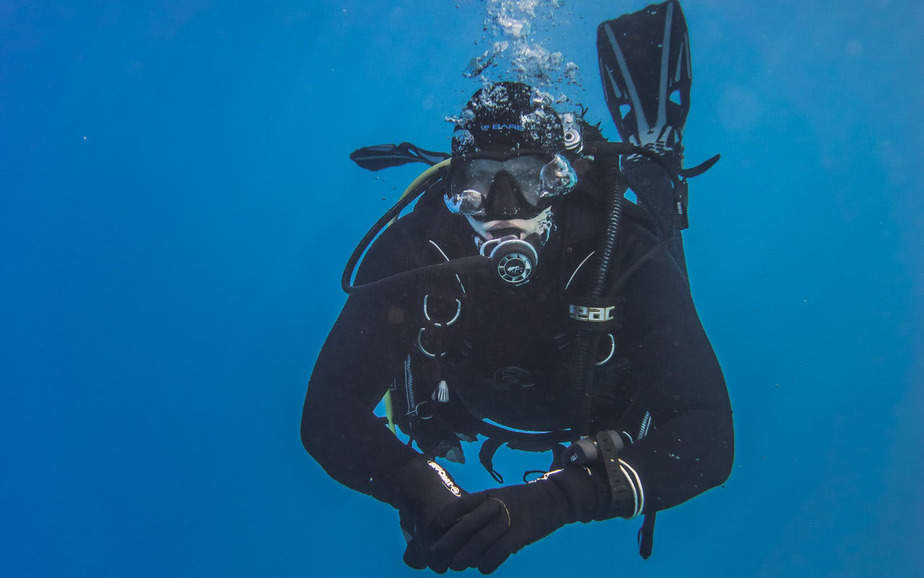
For recreational divers, open up-excursion diving is the obvious selection because of its lower cost and ease of use. In that location's already a lot to worry about when you lot're starting out, so simple is best. With a regulator, you lot don't have to worry well-nigh components like the overpressure valve or the carbon dioxide scrubber failing. You as well don't accept to worry about maintaining or replacing those components.
Another huge benefit of using a regulator is how comparatively cheap it is. It can still cost several hundred dollars, fifty-fifty on the low end. Nonetheless, rebreathers will cost several thousand dollars; it'south just not in the same price range. The price difference is due to the complicated components inside a rebreather.
Benefits of closed-circuit diving
Though airtight-excursion diving is much more complicated and expensive than open-circuit diving, it comes with several powerful advantages, one of which is a much longer bottom time. In a study, it was found that open-excursion divers consumed 17 times as much gas as closed-circuit divers. Since the gas in a CCR is recycled, closed-circuit defined can stay underwater for much longer than open-circuit divers.
Furthermore, despite the significantly higher initial toll of a rebreather, it doesn't quite tell the whole story when it comes to echo expenses. In the same study cited higher up, it was establish that open up-excursion setups "cost 7 times more in expendables" and "4 times as much topside equipment preparation". Time is money, afterwards all, and these expenses can add together up.
Another distinct reward of closed-circuit diving is that information technology is almost completely silent. In a fully closed-circuit rebreather, the gas is not released, which means you don't have to worry virtually disruptive bubbles scaring away all of the aquatic life you lot are observing.
Are rebreathers dangerous?
Rebreathers are not inherently dangerous. They accept some safety risks and the most major 1 is that in that location'due south no backup if one of the components of the rebreather suffers a failure underwater; the consequences tin be fatal. Furthermore, rebreathers are usually used in farthermost forms of scuba diving, such as wreck and cave diving, which are already inherently risky.
In an open-circuit arrangement, when the regulator malfunctions yous tin can switch to using the octopus or switch to a redundant air source easily. At that place'southward no plan B for CCR diving, and so y'all better make sure that the components are well-maintained and in proper working gild prior to diving.
Certifications
Closed-circuit diving is more than advanced and thus requires additional grooming and certifications to better your proficiency. For instance, PADI offers a Rebreather Diver Course. The requirements to sign upwardly are that you accept already passed the Open Water Diver course and the Enriched Air Diver course, are at to the lowest degree eighteen years of age, with 25 or more logged dives.
In the grade, y'all volition get comprehensive preparation on the mechanics of closed-circuit diving, how to perform bubble checks, how to check your rebreather, monitoring gauges, optimizing your BCD and more than.
Furthermore, TDI also offers their Closed Circuit Rebreather Air Diluent Diver class. To be eligible to have this course, you'll demand to have passed their Nitrox Diver course, be eighteen years of age, with 20 or more logged dives.
As function of the form, you'll larn most the history of breathers, differences between open-circuit regulators and closed-circuit rebreathers, dive tables, equipment procedures and so on.
Whether you accept the PADI Rebreather Diver course or TDI's CCR Air Diluent Diver course, you will learn some very important data that will make you lot a safer and better diver. It will accept an investment of time and money, but it's worth it if y'all want to dive a rebreather.
Parting words
Scuba divers are able to breathe underwater using a breathing apparatus that transfers gas from the tank to their mouthpiece. In an open-excursion system, once the air is consumed, information technology is simply released into the surrounding area. In a closed-excursion arrangement, the rebreather will reuse some or all of the exhaled gas.
Regardless of which setup you lot have, both open and airtight-circuit diving offer their ain unique experiences. If yous're only starting out, you should merely stick with using a regulator until you accept a few dives under your chugalug. Only later you lot've mastered the basics should you even consider tackling airtight-circuit diving.
Photograph Credit: SCUBATOO (CC BY 2.0)
hartlinebusbashem.blogspot.com
Source: https://openwaterhq.com/scuba/vs-rebreather-open-closed-circuit/
0 Response to "what are the pros and cons of a rebreather compared to open circuit"
Post a Comment